

On The Shoulders Of Giants . . . 'James Stephens' Speech At Jones' Wood'
Today, as part of our On the Shoulders of Giants series, and on the 125th anniversary of the death of renown Fenian and founding President of the Irish Republican Brotherhood, James Stephens, on the 29th of March 1901, we republish the speech he gave at Jones’ Wood, New York in May 1866.
This speech was delivered just two weeks before the United States based Fenian Brotherhood launched their daring raids into Ontario through Niagara in an audacious attempt to leverage Britain to relinquish it’s rule over Ireland.
Speech at Jones’ Wood
James Stephens
15th May, 1866
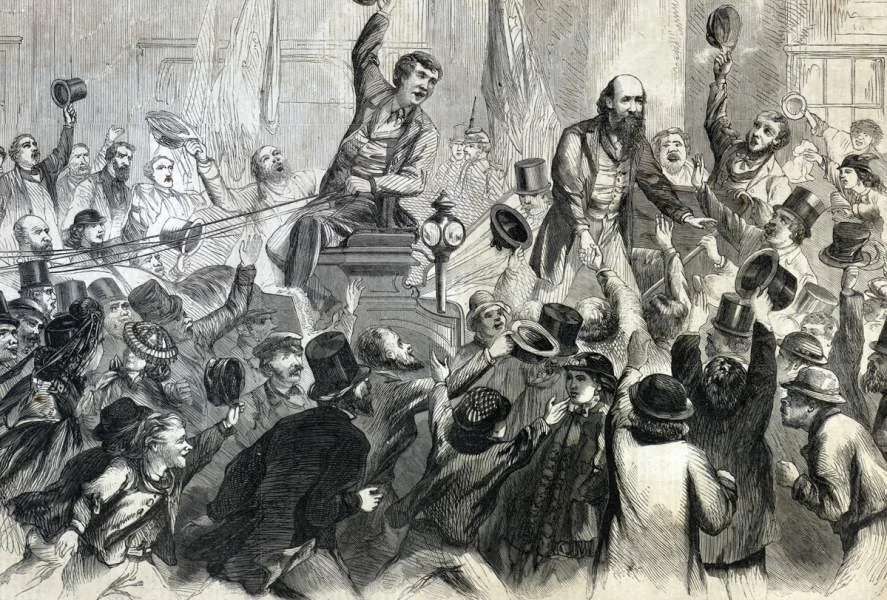
Artist’s impression of James Stephens speaking at Jones’ Wood, May 1866.
Friends of Ireland, — Towards the close of December, 1857, a young Irishman called at my residence in Dublin, bringing me letters from Colonel O'Mahony and from the late Colonel Michael Doheny.
He had also an oral communication to make himself; but all was to the effect that an organization had been established in America, of which Colonel Doheny was appointed the chief, and I was requested to commence an organization and to direct it in Ireland.
At that time the cause of Ireland was so low at home as well as abroad — in fact, throughout the world — that few men of any brains or position could be got to take part in it. They did not know the people. The Irish people were then, as ever, sound. Their hearts were in the right place, and they only required to be shown what to do that they might do it.
On my return to Ireland after seven years' exile, the first thing I did was to travel through the country in every direction to derive a thorough knowledge of the people, and to see what could be done. I devoted a whole year to that, during which time I travelled three thousand miles on foot. (A Voice — " Were you ever in Tipperary? " (Cheers.) Yes, often. There is not a spot from Slievenamon to Ballinderry that I don't know. (Great cheering.)
You know the words of Thomas Davis,
From Carrick-on-Suir to Galtamore,
From Slievenamon to Ballinderry. (Great cheering.)
You see I know it. "With this knowledge of the people I conscientiously answered the letters of my friends in America, and on certain conditions I undertook to organize a force of ten thousand men in three months in Ireland. I undertook to do no more at that time.
The conditions I exacted were twofold. First, that I should have absolute direction and control of the organization. I believe that you know this was a conspiracy, and a conspiracy in Ireland against British rule. And I believe it utterly impossible for any oppressed nationality to organize such a power as could effect its independence without a conspiracy, and without one man having the supreme control in that conspiracy.
For that reason, and for that alone, in the interest of the movement I undertook to unite, I deemed it necessary to make that the first condition — that I should have supreme control of the organization. The second condition was that I should be supplied with certain sums of money per month. I asked for the small sura of from £80 to £100 a month for the first three months. After this time, having organized ten thousand men, I meant to have made other proposals. I sent a trusted friend, who has since been in an Irish prison, to America, on that occasion, with my answer.
On the 17th March, 1858, he returned; he had found no organization in America, only a few devoted men, at the head of which was Mr. Doheny — (a voice — " Poor fellow, I knew him well ! ") — who had held together against all circumstances in America, and who were then endeavoring to keep the Irish feeling alive and make it a power there.
But he found no organization. There was but this nucleus of twenty or thirty men. They accepted my conditions and sent me a paper endorsing, so far as they could endorse it, my action in Ireland.
On the 17th of March, then, 1858, I began the organization in Ireland. As I told you, it was a conspiracy. To become a member of this conspiracy it was necessary to take an oath. You have heard a good deal on the subject of this oath, but perhaps you have not heard my real reason for making it an essential condition of membership.
I had been in the movement in 1848 with Smith O'Brien, and we found when we had a hundred, or two or three hundred men around us, if we happened to meet in any place where the clergymen happened to be against the movement, they invariably spoke against it, and they were able to scatter our force, such as it was.
This was because the people had not been trained ; they had not got the necessary training, and it was necessary to get the people, in my mind, to distinguish between the twofold character of the priest — the clergymen of all classes — to distinguish between their temporal and spiritual character.
"We have invariably inculcated upon our friends the duty of giving obedience and submitting in all devotion to their clergy in their spiritual character, but that in their temporal character they were simply to look upon them as citizens. (Vociferous cheering.) Without this training you never could have a force in Ireland on whom you could reply.
"We then made the oath a condition of membership, and we have continued to make it so. It shall not be changed. (Cries of "Good.") The first instalment of the money sent to me from America (£90), I received on the 17th of March, 1858. The second instalment was to have reached me a month from that; but the months of April, May, and June, went by without my receiving anything.
Then, the second time, I had to send out my trusted friend to America to state the case. The report he brought to New York was favorably received ; but as there was no organization in America at the time, he found it very difficult to get the necessary funds. These came to me in small instalments.
I continued to work, however, drawing on the resources of my friends at home in Ireland; for I want to make you understand that for every dollar contributed in this country, men at home have contributed ten. (Great cheering.)
Finding, about the month of September, that the promise made to me remained unfulfilled, and knowing that I had organized more than ten times the force I had undertaken to organize, I felt the necessity of coming to America to lay the foundation of our work here.
In September, 1858, I arrived in New York, and had a great many difficulties to contend with here. But of these difficulties I do not care to speak at length now, though, if necessary, I shall make them all known to you, but not now. I have too many other points to touch upon.
At length, however, I was allowed to go to work in America, and the first man I enlisted in the organization, or one of the first, was General Corcoran. (Cheers.) At that time the organization in America was a secret society, as it was in Ireland. It has been found politic to change it in that regard since ; it has been changed ; but whether for the better or not the future can only tell.
I travelled through the States and laid the foundation of this organization. On my return to New York a document was drawn up conferring upon me the supreme control of this organization, at home and abroad (cheers) ; in America as well as in Ireland and England, and in Australia — everywhere our race can be found — from that day out.
It was only after a residence of from two to four months in the States I was allowed to go to work, and, as they were impatient for me to return to Ireland, I had only a month to devote to the work of organization in this city, and I had no time at all to collect any amount of funds or arms, or what we needed in Ireland ; but all these things were promised to me.
However, they did not come. I believe this is one of the points upon which you want information — the amount of support we in Ireland have received from here from the beginning of the organization. Well, then, to be brief, during the first six years of the organization in America, we in Ireland received from you about one thousand five hundred pounds.
I have come to America to establish harmony in this organization, and woe to the man who says or does anything to prevent that. (Great cheering.) Let there be no cries against Doran Killian or John O'Mahony, against General Sweeny or Colonel Roberts ; let there be no cries here to-day against any man.
If you have come in a spirit of brotherhood, well; if not, woe to you and woe to Ireland. (Sensation.) Let every man who has come here today, if such be here, for the purpose of creating dissension and discord in our ranks — to widen the breach unhappily existing — let that man go home from here — let him go home. (Cheering). This is no place for him ; let him go to England, that is the place for him — (cheers) — let him go to the British Ambassador ; there he will be received; but let him not stand here with Irishmen who have sworn to free their land or die. (Great cheering.)
I, for my single self, have had my troubles. I have been infinitely more tried by my friends than by my foes; the men who used to call themselves my friends and the friends of Ireland, have proved deadlier enemies to Ireland and me than British tyranny could ever do.
But I must not anticipate. I speak to you in a spirit of brotherhood. I want to have you united, I want to have all our race come into the work, like brother Irishmen and patriots, and any man or body of men who prevents union, I here, to-day, in the face of you all, and in the name of Ireland, brand them as traitors to Ireland and enemies to our race. (Tremendous cheering.)
Our motto to-day shall be union. (Continued cheering.) Each man among us must give up selfishness and shortsighted opinions and come into the great brotherhood. You can all do it. (Cheering.) You are the people, you are the power ; you can make the men, you can direct the men, you can force them into the right way and prevent them going astray from it. (Cheers.)
The duty is upon you to-day, and you must do it. (Cheers and cries of "We will.") To come back to my narrative — for it is merely a narrative, and I mean it to be so, rather than a speech — for the first six years after this organization, as I said, we in Ireland received in all about £1,500.
We were driven almost back upon our resources, and I am sorry that we did not trust to our own resources alone — that we ever looked to America for anything whatever. For, from the spirit of dissension that sprang up, the amount of calumny, misrepresentation, bad feeling, bad blood and scandal that was indulged in in this organization, shame was brought upon us all over the world, and it can only be blotted out by the redemption of Ireland. (Cheers.)
About the year 1863 I found there remained to me three courses to pursue. I had almost despaired of getting anything done from this side, and it seemed to me at home that we were bound to make another effort.
We had then one of the best men the people knew in Ireland. I sent him out here with a statement of affairs. That man has since been condemned to twenty years' penal servitude; he is now a 'felon,' with felon's clothes, doing felon's work, obliged to associate with the assassin, the burglar, the scoundrel, with the scum of the earth, and placed by British law on the same level with those criminals.
He was my trusted friend, a trusted Irishman in the cause of Ireland — learned, patriotic, and accomplished. He was of a trusting nature, and believed the representations made to him here in America. He wrote home in great heart to his friends, all of whom his letter cheered except myself.
His letter brought no cheer to me, for from what I had already heard I knew his mission would be a failure. I knew that from his first letter to me. That was the first course open to me — to send this man to America upon the people's work. His mission was a failure.
The next course open to me was to establish a newspaper in Ireland and get for it as wide a circulation as possible, and devote its proceeds to the organization. You must know that greater difficulties arise in raising money in Ireland than in this country.
I will not give the poverty of the people as a reason for this. Poor as the people of Ireland are to-day, if I could have one month's tour there, as I could in these States, I would raise as much money as would free Ireland.
But I was not free to move about Ireland. It was necessary for me, as head of this organization, to travel with caution, and it was because I did so I was able to escape from arrest so long. But in a short time I received sufficient money to establish the Irish People of which you have heard a great deal.
Towards the establishment of that paper I got no assistance whatever, as every obstacle was put in the way of its circulation, and it became dangerous for a seller to sell it, or a purchaser to buy it ; for the government were watching the sale of the paper.
The landlords and employers, having a large number of people as their dependents, brought their influence to bear, and I am sorry to add that the clergy set their faces against the paper, so that it was difficult to effect a large circulation.
The Chicago Fair was announced, and shortly after, an Irishman who did good service in the cause of Ireland, was deputed to go from Chicago to Ireland to represent the state of affairs to us.
Ostensibly he went to buy goods for the fair, and receive what we contributed ; but in reality came and represented that nothing could save the organization from ruin but my presence in America, and the committee in Chicago were anxious that I should come, else the organization would fall to the ground.
In this narrative I am omitting many details, because I wish to speak in a spirit of conciliation, and I do not wish to let one word fall from my lips to hurt any man. If any word of mine should hurt him by chance I beg bis pardon beforehand, and say that I did not mean it.
I came to the States. The gentleman alluded to is Mr. Henry Clarence McCarty. I asked him, among other things, if the entire proceeds of the fair would be placed in my hands for service in the cause of Ireland, and on his representations and promises I came a second time to the States. I promised my friends in Ireland, on my arrival in New York, to send them £100; on my arrival in Chicago, another £100, and in a week after my arrival in Chicago, £1,000.
The £100 was sent from New York, according to promise; then another £100, and £1,000 from Chicago. For a considerable time I could receive no more money. There was a State convention held in Chicago at that time, and Mr. O'Mahony attended it as well as the centres of the Western States.
Mr. O'Mahony, on being called on to say what was the strength of the Fenian Brotherhood at that time in America, stated that he could not claim more than ten thousand in it.
As my object in coming to the States was to collect money and receive arms in order to bring the movement to a close as soon as possible, I felt that with so small a basis I could not effect my purpose.
I felt that in Chicago on that night, and I continued to feel it for eight or ten days as I went through the States — through towns of Illinois— and it was only when I got to St. Louis that I began to see my way, and felt that if put in proper working order the organization would realize all my expectations in a short time.
And here I may say, that we never required much. Those people who told you that I came over for two hundred thousand, or fifty thousand, or twenty thousand men, or one-half that number, knew very little about me, and still less about Ireland. (Cheers.)
At that time we would have been perfectly satisfied with a few men. All we then wanted was war material. On my return to New York, I had certain changes to propose, which were, in my opinion essential to success.
First, I deemed it necessary that Mr. O'Mahony should have a deputy Head Centre, an able business man, who could make good certain defects in Mr. O'Mahony, for Mr. O'Mahony was always opposed to making direct appeals for money, and it was absolutely necessary that these appeals should be made.
He was also not disposed to go to strange parts of this continent when invitations were not forthcoming. The invitations did not come. Certain other changes I deemed necessary, and these changes effected an extraordinary improvement, which very soon became visible in the organization.
That which had real effect on the people of this continent was, I believe, the statement I made to them in 1864. That statement was to the effect that the organized force at that time in Ireland was sixty thousand men, just six times the strength of your legal, open organization in America; and I made the engagement that if England went to war that year on the Danish question, we should take the field, but that whether England went to war or not, we should take the field in 1865.
What the people wanted here as well as in Ireland was a fixed time for action, and not to be dragged on, as they had been for years, without knowing when the time for action would come. To the statement then made, much of the progress made is to be attributed.
On my return to Ireland, I found that the work was in a very good state, and the report that I brought back from America set the people at work still harder. But still the war did not take place. England fought shy, as she has often since the establishment of our organization. She did not go to war on the Danish question, and we had then one year more to wait.
You held your Cincinnati convention, and about that time I wrote, stating the requirements of Ireland, and asking for the months of January, February, and March, £1,000. I stated I would require for the month of April, £1,000 alone, and for the months of May, June, July, and August, about £2,500 per month. The money for January, February, and March was sent to me — about £1,000.
Another £1,000 was sent to me in April, but I did not get the second instalment till the middle of May, and of the money for May, June, July, and August, I got none. Instead of getting the money I asked for, and which would have enabled us to take the field last year, two gentlemen were appointed here to go to Ireland to investigate our work.
They were perfectly satisfied with the state of affairs in Ireland. They sent over a very favorable report, and asked for money to be sent back to us. It was agreed on at that time that the bonds of the Irish republic should be issued upon their return. It was calculated we should have all that was requisite by the close of the year.
It so happened that one of the delegates, while in Ireland, lost certain documents. This was Mr. Meehan. (There was some hissing when Mr. Meehan's name was mentioned.) Now, I don't wish to say one word disparagingly of him to-day; neither do I wish that any friend of mine should do so ; but while desirous of not saying anything against him, it is necessary that the fact should be known that the loss of these documents was the immediate occasion of the arrests in Ireland. (Groaning.)
I have myself written against him, and if I have wronged him I would be very happy to make ample reparation if he will only favor me with a visit. (Cheers.) I have sent invitations to all those gentlemen — General Sweeny, Mr. Roberts and Mr. Meehan — to all of those gentlemen to come and see me ; but very few of them have come, I am sorry to say.
The fault, however, has not been mine. I have made all the advances compatible with my sense of duty and of dignity. "Well, the arrests were made, and the government said triumphantly that all was over in Ireland. But so far from it, never was harder work and more work done in Ireland than immediately after the arrests. I was free myself, and while free I am not used to be idle. (Great cheering.)
Immediately afterwards, the government saw the necessity of proclaiming every county in Ireland, one after the other, because they felt that the work was going on stronger than ever, and that the only thing we wanted was arms and munitions of war, and these were coming into the country, and they could not prevent their coming in.
They saw that the men who were serving the cause of Ireland were able to baffle them, and that the men got in what they required. What they were able to do then, they are able to do now.
Don't allow yourselves to be blinded upon that subject, nor let yourselves be persuaded by any one that we can't get the means into the country. It has been all a question of money. With the requisite funds we can get in whatever materials we wish, and men too, if we require them.
My opinion on this subject ought to be more than the opinions of the people who have not seen Ireland since the greenness of their youth, and who know next to nothing of Ireland. (Cheers.)
My friends were arrested, and you know how they conducted themselves. The bearing of those prisoners has not been surpassed by the bearing of any men in history, under similar circumstances. And they bore all this because they still had faith — faith in the organization which they knew to be so powerful at home, and also faith that the promises so often made to them, and so solemnly made upon this side, would be kept.
When the counties had been proclaimed, the British press — and how am I to designate that press ? — I believe it to be the vilest in the world, unless it be that foul press of Ireland, which may fairly be designated the journalistic excrements of England — that vile press then began to boast that the organization was suppressed in Ireland.
But only a few weeks afterwards the Lord Lieutenant wrote the precious letter which you must have all read, calling on the government to suspend the Habeas Corpus Act.
You know the wholesale arrests that were made after the suspension of the Habeas Corpus. They thought to make the world believe that we were suppressed then at least, and that was their third attempt.
But I can tell you now that the organization in Ireland to-day is stronger than it ever had been, in numbers, discipline, and in all the requirements of an army, save only in war material.
The organization in Ireland, towards the close of last year, numbered two hundred thousand men. and of that force, fifty thousand were thoroughly drilled, with a large proportion of men who had seen war and smelt powder on the battlefield— a large proportion of veterans, in short; fifty thousand were partly drilled men, and the other hundred thousand quite undrillled.
But if there be a man among you who thinks that fifty thousand Irishmen thoroughly drilled, with fifty thousand others partly drilled, would not make a force sufficient to meet anything that England could bring against us, then indeed he is wofully ignorant of the resources of England.
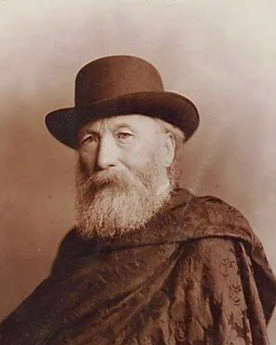
James Stephens
What army could be brought against Ireland by England? What is the military force of England at present ? There are some twenty thousand English troops in Ireland at present, and it would take England from thirty to forty days to concentrate a force of thirty to forty thousand men in Ireland.
It would take her three months at least to concentrate a force of seventy thousand, and it is not likely she would be ever able to concentrate a larger force. Of our forces we could concentrate in Ireland, at four or five given points, one hundred thousand men in twenty-four hours. (Tremendous cheering.)
All we wanted in Ireland from the middle of September to the end of December was arms to put into the hands of our men. The men were there, and only wanted the arms. But, in the very hour of our strength, there came to Ireland the melancholy news of your disruption here.
Still we held on. We did not think it possible that any body of men on this continent could be found that would withhold from Ireland in that supreme hour of her need the succor which they had promised to give us ; and it was because I could not bring myself to believe this that I had made up my mind to get myself arrested, even if the English authorities had not succeeded in doing so ; for I felt myself bound to action last year, and I thought you would feel bound to it here, if I devoted myself so far as to accept a prison voluntarily, and that by going into prison you on this side would be driven to give us what we wanted.
However, before the time I had decided for putting it into execution I heard nothing favorable from this side, and the government found out my residence and I was arrested. I suppose you would all like to know how I got out of prison. (Tremendous enthusiasm.)
Well, it did not require any extraordinary effort on my part, for with the force of true hearts that were around that prison in Dublin it would not have been possible for the government, though the walls had been of adamant, and though it had regiments stationed within those walls, to keep me there. (Great cheering.)
To my friends in Dublin, then, I refer you for the manner in which I effected my escape. That was the time of our greatest power in Ireland, and if, at any time between the 24th of November and the end of December, you had sent to Ireland a small force, or only a few superior officers with the necessary war material, I do believe, as firmly as in my own existence, that Ireland would be an independent country to-day.
But you know what took place. However, my mind was made up not to leave Ireland, and so I remained for nearly four months in Dublin city after my escape from prison. At length I had an invitation from Mr. O'Mahony and others to come to this country, for the organization, it was said, required my presence here.
The evening after the reception of this invitation, I called some of my most trusted friends around me to hold a council, to see, before I determined on starting for America, if something might not be done at home even without your assistance. It was determined on that night, even without asking for my voice, to defer action yet awhile. It was then and then only that I determined on coming to the States.
Once determined on I set about its execution, or rather my friends set about its execution, for I was in their hands, and indeed it is to them and not to any effort of my own that everything is due. This departure from Ireland was much more difficult and much more full of incident than the escape from prison.
But I do not care to dwell on it now. I want to come to the object of my mission to America. You know by this time that it is to reconcile the parties here and to effect a union — such a complete union as would give us very speedily all that we want for the freedom of our land.
I found the organization here torn asunder, and, as already said, all sorts of bad feeling among the members. But I still believe that, from what the people have shown to me since my arrival in the States, I can effect enough for all our purposes. (Cheers.)
It will give me the greatest possible pleasure, and it will give Ireland great pleasure, and the men who are now pining in prison, and the men who are standing in the face of all difficulties at home ; it will give them infinite pleasure to see the heads of the sections coming into this organization united once more. (Cheers.)
As already said, I have made advances for that purpose, and so far as I recollect I have not as yet let fall one single word that could fairly hurt any of these gentlemen. I did expect that Mr. Roberts would have acted like Mr. O'Mahony. I believe it was patriotic and wise of Mr. O'Mahony to have given in his resignation, and I believe it would be patriotic and wise of Mr. Roberts to do the same; and if Mr. Roberts and Mr. O'Mahony passed on this platform to-day, forgiving one another, forgetting the past, stretching forth the hand of brotherhood one to the other, and calling on the men to work together — if they had been here to endorse me, I believe that the organization would have in a single month ten times the power it ever had, and that the liberty of Ireland would be a certain thing. (Voices, Down with them! pitch them overboard!)
Mr. Stephens (emphatically) — I have already called on you not to say a word hurtful to anyone. I have a great respect for Mr. Roberts and Mr, O'Mahony, and for every man till he is proved to be dishonest, and, once proved to be dishonest, I am then done with him for ever.
But nothing of the kind has been proved against any of these gentlemen, so you have no right to hoot at them, no matter who may have set you on. Here, publicly and before the Irish people, I once more in a friendly and fraternal spirit invite these gentlemen — the heads of all parties — to come to me while I remain in New York, and endeavor to come to an understanding.
I call on the Irish people here and throughout the world — for I believe the words I pronounce, however simply spoken, will be read wherever our race can be found — I call, then, on our whole race to rise up against the man or body of men who would stand between Ireland and this essential union to-day.
I appeal to you by all you hold dear, by the memory of that land so fair, so full of sorrows, and yet so steadfast, so resolute, so pure, and enlightened as it is today. For I claim for Ireland at this hour more true republican principles and lights than are to be found in the same number of people in any country on earth. (Cheers.)
And if there be more anywhere else, it must be on this republican continent. But certainly, I do say this, and I say it deliberately— for I know that these words will be read in France and in other lands that are so very dear to me, for France I do love. (Prolonged and enthusiastic cheering.)
I say that not even there nor in any other land in Europe is there so much republican intellect as in Ireland. I say that we are well worthy of liberty, and that we are able to win it, if you do not deceive, or rather if you do not disappoint us in any way.
In fact I might let the first word stand, for indeed if you disappoint us then you will truly betray us. You must disappoint and betray us if you are not united. This unity of action is the grand essential to-day ; you must labor for that, think of nothing else but that, and don't rest till you have effected it. (Cheers.)
Countrymen and friends of Ireland, for very important reasons I shah not extend my address to you to-day, but through the press and elsewhere you will hear of me again. The last words I shall say to you now will be but a repetition of what I have already said.
Without unity we cannot have what we require, and you cannot fulfil your promises to Ireland ; the Irish people are sure to be disheartened and dispirited ; the organization is sure to be broken up, and an eternal stain will rest upon our character ; but, worst of all, the whole Irish race is sure to be exterminated. (No, no.)
It is certain that the Irish people will be driven from the soil of Ireland if you do not free her. If there is not union I believe the whole movement will end in failure, and then the doom of your race will be sealed. Behaving, then, that union is the great want of the present time, I have in many ways cut short this address to avoid any remark that might be considered fairly hurtful to any man.
Once more, I repeat, I stretch forth my hand to any man who may come to effect this union ; and I call on you now, in the name of Ireland, to allow no man to stand in the way of this unity. (Cheers.)
Effect it, and as sure as I address you here to-day we shall take the field in Ireland this very year, and by effecting it we will have a free land. Brothers, as my object to-day is to endeavor to effect this unity, I deem it wise that no other gentleman should address you on this occasion."