
On The Shoulders Of Giants . . . 'Emancipation' - Frank Ryan
Today, as part of our On The Shoulders Of Giants series, and on the 82nd anniversary of the death of Irish socialist republican revolutionary, Frank Ryan, we republish his pamphlet ‘Emancipation’, which he wrote under the pseudonym ‘Seanchránaidhe’.
Ryan wrote this pamphlet for the centenary of the 1829 Catholic Emancipation Act, which removed the ban on Catholics sitting as Members of Parliament in Westminster. This achievement led to Daniel O’Connell’s beatifying, both in Ireland and abroad, as ‘The Liberator’.
However, as Ryan points out, the Catholic Emancipation Act contained a requirement for all MPs to swear an oath of allegiance to the English Crown. Alongside the Catholic Emancipation Act, a second act was passed, this one aimed at disenfranchising those same Catholic peasants who voted for O’Connell. This act, known as the Parliamentary Elections (Ireland) Act, restricted the right to vote from lower income peasants.
During the heady revolutionary times of the United Irishmen, a concession was won from the English Parliament which gave the right to vote to all men who owned property worth at least forty shillings (£2). The 1829 Parliamentary Elections (Ireland) Act raised this threshold to 200 shillings (£10). Meaning that ‘post emancipation’, the vast majority of Catholics in Ireland i.e. the small landholders, the propertyless and all women, were left without any representative voice in the English parliament and remained as such in the lead up to and beyond An Gorta Mór.
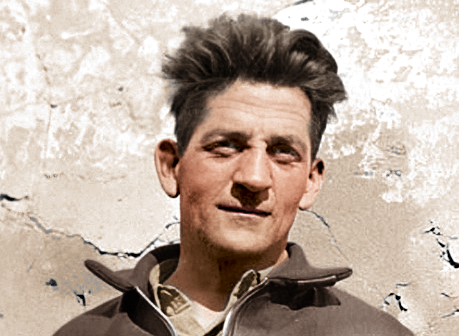
A photograph of Frank Ryan taken in Spain while he served with the Connolly Column fighting Francisco Franco’s fascists.
Emancipation
By “Seachránaidhe”
The Irish Republican Press Limited
1929
Foreword
History – as we are taught it – hath it that for centuries the Catholic religion was persecuted in Ireland, and that, one hundred short years ago, that persecution was suddenly and miraculously ended by the exertions of a man who has been styled “The Liberator”.
So it happens to-day that the commemoration of the event known as Emancipation is, to a great extent, merely the glorification of the man known as the Liberator. Press and pulpit, with an eye to the requirements of 20th century publicity, but with less wisdom than enthusiasm, have woven about the century-old event and its principal figure a story that makes exhilarating reading.
Politics and religion are mingled in it, the event is misnamed, the story is misleading, but – under the guise of good Catholicism – all passes for fact.
A fallacious conception of history is fostered by these publicists. We are told by them that the Catholic section of the Irish people lay for centuries under a terrible sectarian oppression, while the Protestant section, their oppressors, feasted on the fat of the land.
We are told that these Protestants. Actuated by a hellish hatred of Catholicism, suppressed and sabotaged their Catholic countrymen. Grim pictures of the sufferings of out forefathers are depicted, by which our sectarian animosities are roused, so that by hatred of our fellow-Christians we may become zealots of our own creed.
Finally, we are told how this now almost canonised “Liberator” raised the Catholics of Ireland from the mire of slavery, and in one great effort, emancipated Ireland,- without (mark it!) the shedding of a single drop of blood!
That the Penal Laws were directed, not against the Catholic religion, but against the Irish nation is the first contention I shall make in this booklet. That Daniel O’Connell was not the Liberator but the Enslaver of his country is the second. I shall then deal with his achievements – real and alleged – concluding with the Great Myth of 1829.
I, who am an Irishman and a Catholic, resent the mingling of religion and of politics. In common with all the decent-minded men I abhor sectarianism; in common with the majority of my countrymen I abhor the political creed of the Liberator as the most degrading ever practised in Ireland.
Finally, I protest against the sham of Emancipation Celebrations in an Ireland where Penal Laws are enforced north and south – where the liberty of the subject has ceased to exist, and where to seek the true emancipation of Ireland is dubbed a crime.
In bare justice to the real Emancipation of Ireland – the physical force men – I have thought it well to set forth in the following pages what I know and believe to be the Truth about Emancipation.
Emancipation
the penal laws
A military defeat left Ireland at the mercy of England in 1691. The conquerors, wise with the experience of five centuries of attempted conquest, were determined that this defeat should be decisive. Accordingly, the “scrap of paper” signed at Limerick was cast aside and the Penal Laws became the Constitution of Ireland.
The aim of the conquerors (frankly admitted by themselves), was to render the Irish people impotent in Ireland, by subjugating the nine-tenths of native stock to the rule of one-tenth who were Planters. It so happened that Ireland was a Catholic country and that the conquerors were Protestant.
This difference in religion was but an incident. Had Ireland been a Protestant country, Penal Laws would have been enforced.
Or, had the conquerors been Catholics. There would still have been Penal Laws. For, the Penal Laws were not framed for the advancement of one religion, nor for the advancement of one religion, nor for the suppression of another, they were not anti-religious, but anti-Irish.
Penal laws not anti-catholic
That the idea of converting (or perverting) Ireland to Protestantism was never entertained by the framers of the Penal Laws is testified to by many unbiased historians, and in fact, is self-evident in the clauses of the Laws themselves.
“Whereas Catholics have been really persecuted for religion:, says one historian, writing of this period, “’enlightened’ Protestants (in Ireland) only made a pretext of religion; taking no thought what became of Catholic souls, if only they could get possession of Catholic lands and goods.”
“One peculiarity is to be remarked in the administration of these laws,” says Mitchell, “they were so applied for generations, as to allow a bare toleration to Catholic worship . . . . although this was contrary to an expressed law (The Act of Uniformity) . . . . . There was no such relaxation as this allowed in any matter relating to property, privilege or trade; in all these matters, the code was executed with the most rigorous severity.
So, that it is plain the object of the Ascendancy was not so much to convert Catholics to Protestantism, as to convert the goods of Catholics (ie. Irish) to Protestant (ie, English) use.”
The argument expressed in these quotations is supported by the text of the Penal Laws themselves. Noe of the first is entitled: “An Act for the better securing the Government, by Disarming the Papists.” There were Acts against Education, and against the possession of Property. All aiming at the impoverishment and degradation of the Irish people so that by being disarmed, disposed and degraded, they might the more easily be kept in subjection.
For half a century after the Williamite war, administration in Ireland was based on the Penal Laws. Denied education, debarred from all professions, and deprived of their arms, the Irish people were absolutely subjugated.
And, saddest feature of all, the country was being drained of its manhood: a constant stream of recruits poured into the various Irish Brigades on the Continent – half-satisfying vengeance – to fight and win the battles of England’s enemies.
a day of hope
Yet, the fear of a resurgent Ireland still lurked in English minds. Wherever the Irish at home congregated, there the English scented “sedition.” So even the pattern and the fair were prohibited – lest revolution be taught there – and a fine. Or a whipping, was the penalty for him “who shall attend or be present at any pilgrimage, or meeting held at any holy well.”
The years passed. Came a day of hope. On the Continent, the crack corps of the British Armies were being routed, in a succession of campaigns, and the British military prestige waned, until in the bloodied bayonets of Ireland’s victorious “Wild Geese” at Fontenoy, it smashed down in defeat.
At home, a flush of hope lightened up the night of despair, and the old folk fondly prayed that their fighting-men might return with arms flashing for vengeance and for freedom.
Hot on the heels of Fontenoy came the return of the Young Pretender to Scotland. English domination of Ireland was threatened as it never had been for centuries before. At all costs (decided the English rulers) Ireland must be induced to remain at peace.
So, where the whip of coercion had failed, the sop of conciliation was now employed. No Penal Laws were repealed, ‘tis true, but neither were any existing ones enforced.
Under an amiable Viceroy, specially appointed. Forbearance and tolerance was the order of the day.
So, while Prince Charlie’s Highlanders, having routed an English Army at Prestonpans, were marching on London and while the Franco-Irish soldiers were essaying a descent on the shores of England, Ireland was at peace.
Nay, more. The Catholic Bishop Berkley of Cloyne, prototype of that class of ‘Cawstle Cawtholics” who were even now being conceived in the womb of cringing, petitioning slavishness, fearing that his flock were secretly engaged in a conspiracy to make Ireland independent, was exhorting them by Pastoral. In kind and paternal manner to keep the peace. The sop had done its work.
Scotland’s hopes were submerged in the blood-sodden field of Culloden, and with them died Ireland’s.
“England (says Plowden) was put out of danger, and Ireland could securely be put under its former regime.” Accordingly, the amiable Viceroy returned to England.
“the poor always right”
Dispossessed, degraded and disarmed though they might be, the plain people of Ireland ever realised, with surer instinct than their wealthier countrymen and co-religionists, the real purpose of the Penal Laws under which they suffered.
While slavish Irishmen, Catholics in religion, protested and petitioned for “permission” to amass wealth, the poor instinctively realised that it was not Catholics who were being oppressed, but Irishmen. They saw that Catholic rich and Protestant rich alike were their oppressors. *
And, as all the laws were framed and directed against the mass of the people; as the courts of justice were entirely in the possession of their oppressors and as law and justice were not at their disposal, they fell back on the only recourse of a proscribed race – conspiracy.
So, originated a secret society in every parish, poor but potent successors to the Rapparees. So, originated Steel-Boys and Oak-Boys and White-Boys, the precursors of Ribbonism which begat Fenianism, which in turn begat other conspiracies which will persist, in some form or other, until Ireland has achieved her Emancipation.
THE RISE OF THE “CASTLE CATHOLIC”
The latter half of the 18th century saw the rise of a moneyed class of Irishmen, who were Catholics and who were loyal to England. They abhorred violence and were as bitter foes of the White-Boys as the Dragoons themselves. They represented that class which had been conquered by the Penal Laws, as the White-Boys represented the masses who had not. The only weapon of these loyal Catholics was petition, which they used to protect their interests from their English rivals in trade.
So, while a Catholic aristocracy was being cast in the Imperial mould, the masses, groaning under the exactions of tithe-proctors, and rack-renting landlords, were subjected to the full rigour of the real Penal Laws.
The conditions under which they existed are thus summarised by Mr. Young, and honest English tourist, whose “holiday” experiences in Ireland at that period must surely have been the most gruesome ever recorded:
“Acts were passed for their punishment, which seemed calculated for the meridian of Barbary; this arose to such a height that one by one they were to be hanged under circumstances without the common formalities of a trial . . . . while others remain yet the law of the land, that would if executed, tend more to raise than quell an insurrection.
From all of which it is manifest that the gentlemen of Ireland never though of a radical cure, from overlooking the real cause of disease, which in fact lay in themselves, and not in the wretches they doomed to the gallows. Let them change their own conduct entirely, and the poor will not long run riot.”
But the Planter “gentlemen of Ireland” neither then nor subsequently changed their conduct. Rather, in alliance with the new-coming loyal Catholic gentlemen – did they intensify it.
A CHANGE OF MASTERS
The Irish nation would, almost certainly, have been annihilated in the latter half of the 18th century, were it not for an event which changed the destiny of England, and indirectly checked the prosecution of English designs in Ireland. This event was the revolt of the English Colonies in America.
Up to this, the English colonists in Ireland had been ruling the country in the interests of England. Fired by the example of the rebellious English garrison in America, they now sought to rule Ireland for themselves. They established a Volunteer force, the Catholic merchants liberally supplying the money, and demanded an independent Irish Parliament for themselves.
Lest this redbelly spirit infect the masses, the English policy of 17435 was perforce again repeated in Ireland. Coercion ceased; conciliation replaced it. In 1774, the English King, by Act of Parliament, recognised Catholics as his subjects, giving them permission to swear allegiance to him!
With the shadow of revolt looming larger in America, further efforts were made to keep Ireland in peace, further concessions were granted, to make loyal British subjects of Irishmen.
So in 1778, we find it enacted that an Irishman could practise the Catholic religion openly, and could take land on a lease of 999 years. In 1782, the British garrison in Ireland got permission to open schools, subject to the approval of a Garrison Bishop.
THE ISSUE DEFINED
Just when the Garrison was settling down to the task – now rendered more easy – of keeping the Irish people in subjection, Fate again gave Ireland its opportunity. The millions of France, who had for long groaned under a terrible tyranny, rose in revolt and in one great thrust struck down their tyrants. That blow, reverberating round the world, was heard by a young barrister in Belfast, Theobald Wolfe Tone.
Tone, a Protestant of garrison stock, clearly understood the why and the wherefore of the Penal Laws. He realised – more clearly than the majority of his fellow-countrymen – that it was not religion that was threatened by them, but the Nation.
Therefore, in the ranks of the United Irishmen, he prepared to rally the oppressed of all creeds and to meet the issue as it should be met – not on the basis of privileges for denationalised Catholics, but on a basis of freedom for the Nation, and the dictatorship of the people.
The British government, for its part, saw with alarm the issue thus clearly put. Hating and fearing the capable leader opposed to them, they concentrated in an effort to crush him.
Hitherto, they had successfully kept the red-herring across the path of Irish freedom; they had let it be understood that Catholic versus Protestant was the issue, and with a just contempt for the dupes who imagined they were being persecuted for their religion, they had occasionally granted a concession in return for assurances of loyalty.
Face to face now, with a revolutionary leader, their first step was to procure as many dupes as possible.
CONCESSION THROUGH FEAR
So, from 1791 to 1798, it was a race between Tone and the English Government for the allegiance of the people; Tone essaying to inculcate self-reliance in them, and asking them to emancipate themselves, in arms; the English Government, on their side, buying and bribing their Irish Catholic slaves to allegiance.
Concession followed concession; the Irish slaves took their sops and asseverated and reasseverated their allegiance. In the space of a few years, the greater [part of the Penal Laws were repealed.
The Irish were permitted to teach schools without the consent of the Garrison Bishop in 1792. They could, too, serve in the British Army. A very wise concession. Tone had an army for them too!
In the following year the concessions were more far-reaching and still: Irish (Catholics) could be lawyers, jurymen and councillors. And (greatest concession of all), The Forty Shilling Freeholders could vote.
The Irish slaves were bought and thus prevented from learning Tone’s truths. And – final concession – lest they might learn them in resurgent France, the Catholic Clergy were allowed to open ecclesiastical schools in Ireland.
So, Carlow Ecclesiastical College was opened in 1791. Four years later Maynooth College was established, with an English Government Grant of £8,000 per annum.
These tactics were successful. The Irish slaves were bought. Pulpits thundered forth against “conspirators”; pastors importuned their flocks to hand up Croppy pikes to their oppressors. Against them Tone led a forlorn hope, and failing, paid in death the penalty of patriotism.
Tone disposed of, the rest was easy. The very pastors who had discountenanced revolt were themselves goaded into rebellion. Too late did Wexford rise; bloodily was it suppressed.
But, the craven Catholics who heeded not Tone now hearkened to Pitt. Lured by another promise of Emancipation – rather, of privileges for themselves – they helped to abolish the Irish parliament.
Once again, they asseverated their abhorrence of treason, and their loyalty to the Crown, and sold their country. Joyce, mild and moderate historian though he might be, cannot help commenting on this base treachery of the opulent Catholics. “Had they opposed it,” he says, “the Union could never have been carried.”
Thirsting for place and power, the rich Catholics clutched at the empty promises of Pitt. To become members of Parliament, and to hold some few positions of privilege was all that was still denied them. When the Union was accomplished, they got neither from Pitt; one will agree that they deserved neither.
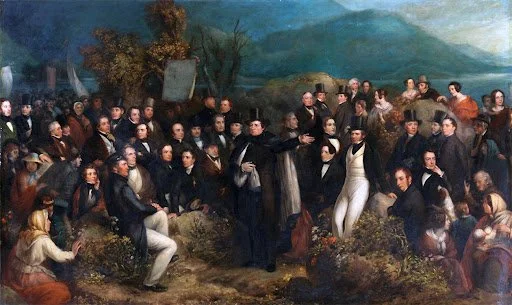
Close-up picture of one of O’Connell’s monster meetings which depicts the propertied Catholic gentry listening attentively to O’Connell. These wealthier Catholics enjoyed much closer proximity to O’Connell than his hundreds of thousands of peasant followers, politically, economically and culturally.
the liberator
Five years after Tone’s death. The aspirations of the masses found expression in revolt, Robert Emmet rose in arms. He failed and paid the penalty on the scaffold.
Among the Croppy-hunters who tracked down Emmet’s followers was a Yeoman of the Dublin Lawyer’s Corps – one Kerry youth named Daniel O’Connell. He was a Yeoman of some years standing, as he tells us himself; 1803 was not his first campaign.
Like many Yeomen he had been infected (albeit slightly) with the ideals of the United Irishmen. Whilst serving in the Yeomen in the first days of the Revolt of 1798, his martial ardour suffered a sudden decline. Suspect United Irishmen were being taken from the ranks of the Yeomanry, thence to face firing squads.
O’Connell, fearing arrest under such circumstances, left the Yeomanry, shed his United Irishmen principles (if he ever had them), and took boat for Kerry and neutral territory. One has good reason to date the birth of his Moral-Force cant from that day of desertion.
O’Connell was master off an Orange Lodge from 1799 to 1802. This Orange Lodge Master, this Croppy-hunter, this self-confessed renegade United Irishman quite consistently – if one may associate the word with such as him – professed a contempt of Irish revolutionaries.
Sufficient index to his character is that he who would willingly shed the Croppy’s blood, proclaimed nevertheless that the freedom of Ireland is not worth the shedding of a single drop of blood.
THE ERA OF AGITATION
Tone and Emmet were lying in their graves. The man who had opposed them, and vilified them now came to the forefront. The agitation for Emancipation -in reality for privileges for rich Catholics – was initiated with O’Connell as its leader.
An orator possessing the highest degree of excellence, a lawyer of remarked sagacity, he rallied the millions of Irishmen around him. Trustingly, they hearkened to him, faithfully they followed him. He promised them emancipation – freedom – and assured them they could win it without war.
Their aim was a free Ireland; his- though they knew it not – was power for Catholics loyal to the English Crown. He was to be their leader. They were to follow him blindly. “He would emancipate them”; these were his terms.
And, accepting these terms, the Irish people, were to become pawns in the game. Self-reliance – the watchword of the true emancipators of latter days – was not. So, Colossus-like, O’Connell bestrode the Irish stage, dictator to the herded masses.
Of his Emancipation agitations, I cannot treat in detail here. His hostility to democracy, his capitalist outlook, his attack on what represented Labour, his opposition to Irish culture and language, his craven, cringing loyalty, his many personal vices – all must pass here without comment.
We are concerned, for the moment, only with O’Connell, the leader of an Emancipation movement, and with his policy.
ALLIANCE OF CHURCH AND STATE
We have already seen how the anti-Irish Penal Laws were successful in creating a moneyed class of Catholics, who, by opposing revolutionary efforts assisted in the enslavement of their country. O’Connell belonged to this class, and it was their rule he desired.
This class, which had in its ranks the greater number of Irish Catholic Bishops, was opposed to the aspirations of the masses, and looked upon popular movements with distrust.
“There was a very good reason for the distrust with which Church and State had regarded movements for political reform in the long ages before O’Connell’s time. Such movements aimed at revolution, carnage and bloodshed as the ordinary and indispensable means of attaining their respective ideals.
But O’Connell showed the world a better and nobler way. By a wonderful stroke of genius, he discovered, or invented, the method of constitutional agitation.”
Thus does a disciple of O’Connell seek to justify the alliance of denationalised Bishops and an alien government; thus, by excessive praise, does he seek to prove the efficacy of “moral force” over what he is pleased to call “carnage.” Of the way that is “nobler and better” than that of Tone (to which it is contrasted) I shall speak more later, when summing up its results.
Suffice it for the moment to say that “constitutional agitation” was prolific of denationalising effects, and that it took a century of effort and three revolts to end its demoralising course.
AGITATION OR REVOLUTION?
Why, may one ask, was the temporary relief from the Penal Laws in 1745, conceded to Irishmen? Was it constitutional agitation procured it, or was it the fear of an Irish revolt? Let the Moral-Force loyalists answer.
In the period between 1774 and 1782, as we have seen, some Penal Laws were relaxed. Was it constitutional agitation procured that respite from coercion, or was it the fear of an Irish revolt? Again, let the Moral-Force loyalists answer.
And, when Penal Laws were revoked wholesale between 1791 and 1798, was it the constitutional agitators we had to thank, or was it Tone and his United Irishmen? Faced with facts proven from history, the Moral-Force loyalists may well relapse into silence.
So, too – after years of agitation – when the movement for Emancipation reached its climax in 1829, let us see to what extent – if any – constitutional agitation was responsible for the Relief Act of that year (which is to-day glibly misnamed Emancipation). Sir Robert \peel was the proposer of that Act for the relief of “the civil disabilities of His Majesty’s Roman Catholic Subjects.” Let him tell us why he proposed it:
Writing to Dr. Jebb, Bishop of Limerick, in February, 1829, Peel says, “It is easy to blame the concessions that were made in 1782 and in 1793; but they were not made without an intimate conviction of their absolute necessity to prevent greater dangers.”
Again: “I can with truth affirm, that in advising and promoting the measures of 1829, I was swayed by no fear, except the fear of public calamity.” In the House of Lords of England, the Duke of Wellington, moving the second reading of the Relief Act, urged its necessity in order “to prevent civil war.”
So much for the claims of the Moral-Force loyalists and their constitutional agitation.
THE GLORIOUS ACHIEVEMENT!
Let us now deal with that Emancipation secured in 1829. First, let it be noted that the title is a misnomer. Three Acts were passed in 1829. They were –
(1) An Act for the Suppression of the Catholic Association as an illegal and Dangerous Association.
(2) The Catholic Relief Act.
(3) An Act for the Disfranchisement of the Forty Shilling Freeholders in Ireland.
The first Act could have no serious consequences, as the Association could be revived under another name.
The second Act (Relief Bill) abolished the old oath against Transubstantiation and substituted another for the exclusive use of Irish Catholics. Any one taking the new oath had to swear allegiance to the Crown, promising to maintain the
Hanoverian King and his successors; solemnly disclaiming, disavowing and abjuring any intention to subvert the Church Establishment as settled by law (ie., the Church of England to be the Established Church of Ireland): declaring too, that neither the Pope nor any other foreign prince has any temporal or civil jurisdiction within the realm; promising to defend the settlement of property as established by English Law, and finally engaging never to exercise any privilege conferred by the Act “to disturb or weaken the Protestant religion or Protestant government.”
PRIVILEGES AND RESTRICTIONS
After swallowing that oath, an Irishman could become a member of the Imperial Parliament, and could compete with the privileged ones for Dublin Castle jobs. But, here there was a restriction: an Irish Catholic could not be either a Lord Lieutenant or a Lord Chancellor.
Now, the Lord Lieutenant had the whole administration in his hands – many privileges and positions under his control. He could grant pardon -or what is of equal importance in Ireland – refuse pardon. The Lord Chancellor controlled the remainder of the administration. He nominated magistrates and cancelled their commissions at will; he regulated the guardianship of minors and decided in what religion they were to be reared, in the absence of express direction of parents.
Between Lord Lieutenant and Lord Chancellor, the alleged Emancipation was turned into a mockery. Of what use to an Irishman to be eligible for a Magistrate’s Commission; the Lord Chancellor need not accept him. Of what use to be eligible as a County Inspector of the R.I.C., for instance; the Lord lieutenant would certainly never agree to him. So far as administration was affected, Emancipation Bills made no difference.
EMANCIPATING THE POOR
The third of the Acts, was that which disenfranchised the Forty-shilling Freeholders. It neutralised any of the possible benefits of the Relief Act proper. By it, the masses were disenfranchised. Thus, the people who had raised O’Connell to power were abandoned by him. They won him Clare -they had defied their landlords and voted for him, believing they were helping Ireland. He now abandoned them to a terrible fate under this Act.
“It is singular,” remarks Mitchel, “that O’Connell said not a word at any meeting, nor wrote any letter, protesting against this wholesale abolition of the civil and political rights of those whom he owed his election for Clare.
He thus consented by his silence to see cut away from his own feet the very groundwork and material of all effective political action in Ireland; and often afterwards had occasion, as Ireland also had, to lament the impotence and futility of all patriotic effort for the real advancement of their country, in consequence of the destruction of the forty-shilling freeholders.”
See there the achievement of Moral-force and of constitutional agitation! Even the self-dubbed Liberator realised that nothing had been gained. Not only was the civil and political inferiority – the real aim of the Penal Laws – still maintained, but the mass of the population was swept out of civil existence.
Emancipation! Peace! Constitutionalism! See Ireland in Emancipation year:-
“This year, Ireland was said to be in an ‘alarming’ state – there was ‘crime and outrage’ in several counties, and especially in Tipperary . . . . The Tipperary magistrates assembled in great alarm, and demanded the immediate application of the ‘Insurrection Act’ . . . .
“In truth there was throughout the island, a very unsettled and uneasy condition of the popular mind. Men were told that they were ‘relived’ and ‘emancipated,’ but they felt no advantage from it whatsoever.
They tried to feel pride in the victory which they assured they had won’ but in the meantime they found themselves disfranchised; and what was worse – landlords were refusing to make new leases . . . The chairmen of quarter-sessions, and the sheriffs and the bailiffs were busy with their ejectments; and pauperism began extensively to prevail . . . for all this there was no remedy in Emancipation.”
“CONSTITUTIONALISM”
Such were the material results of the Emancipation we so gaily celebrate this year. Equally evil were the moral results. Let us summarise them:-
The acceptance of the Acts of 1829 was the first formal acknowledgment of British citizenship by the Irish people. The oath which was substituted for the oath of Transubstantiation bound those who took it to fealty to the British Crown.
O’Connell’s moral force cant begat constitutionalism = the sorriest movement ever promoted in Ireland. Irishmen ceased to rely on themselves and went a-begging to London. It took almost a hundred years and three revolts to undo the harm done to the national morale by that slavish movement.
By Emancipation, the moneyed class mainly loyalists – were made masters of Ireland. The disenfranchising of the Forty-Shilling Freeholders, and the raising of the valuation to £10 placed our destinies in the hands of the landlords.
Ireland might be emancipated (if O’Connell were to be believed), but its “emancipation” was -mainly through him – from its culture and traditions. For the age of Shoneenism began in Emancipation Year. The decay of the Irish Language, the decline of Irish Culture followed Emancipation.
THE NEW GARRISON
Let Mitchel tell of the rise of the “Castle Catholics,” the spiritual fathers of the Emancipation boosters of this year:
“It soon became evident, also, that the effects of the Relief Act would be disastrous in another respect. Parliament and the Judicial Bench being now opened (always with the exception of the place of Lord-Chancellor) to aspiring Catholics of the educated class, their interests and sympathies became separated from those of their countrymen.
Undoubtedly, this result had been calculated by the prudent statesman who accomplished the Relief measure; and his plan succeeded but too well. That plan may be described. In general terms, as a plan for corrupting the higher classes and extirpating the lower; and Emancipation, disenfranchising the latter and offering bribes to the former, was admirably calculated to buy over to the British interests such as aspired to the offices and emoluments dispensed by England, and to make them forget the duty they owed to their own countrymen, and the honour and welfare of their native land.
Since that day, therefore, we have seen constantly more and more of the higher class of Catholics, in various positions, helping England to govern – that is, to pillage and depopulate – this ill-fated island.
Since that day have been many Catholic members of Parliament – they have solicited places for useful constituents. Catholic attorney-generals – they have packed juries to do the ‘King’s business.’ Catholic judges – they have sat complacently on the bench, and permitted those juries to be packed, and pretended to try their fellow-countrymen before those packed juries, to glut the vengeance of a Government which cannot bear to be disquieted while clearing off its ‘surplus population.’
In other words, those members of Parliament, attorney generals, and judges, have sold themselves for money and station, to a Government which they know to be the mortal enemy of their countrymen and kinsmen, and have abandoned those countrymen and kinsmen to certain slaughter and extermination.”
THE ROAD TO EMANCIPATION
So much for the Liberator and his Emancipation. In sober truth, O’Connell was not the Liberator, but the enslaver of Ireland. Instead of the manly doctrine of self-reliance, he preached the debasing doctrine of constitutionalism.
The real Emancipators of Ireland were the physical force men – Davis, Mitchel and the Young Ireland men, the Fenians, and later the men of 1916. Their successors alone will emancipate Ireland.
For my part. I would have Irishmen remember one incontrovertible fact, and remembering it, act upon it:
The issue in 1829 (or at any time previously or subsequently0, was not privileges for any creeds within the British Empire; it was the plain issue of Ireland’s Freedom – the same issue which has been since 1169 and will be until Irishmen achieve Emancipation.
For, the continuance of a limited freedom – or the achievement of full freedom – does not depend upon any Act of Parliament, nor upon any Treaty. It is by Irish will and not at English pleasure that Emancipation can be achieved: Irishmen must emancipate themselves – in arms.